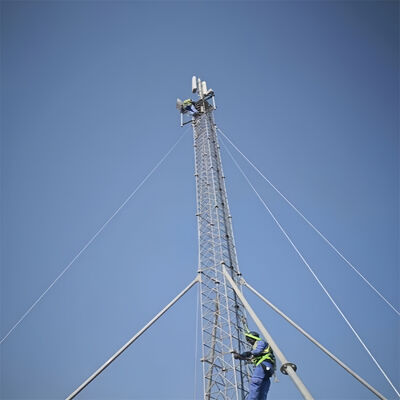
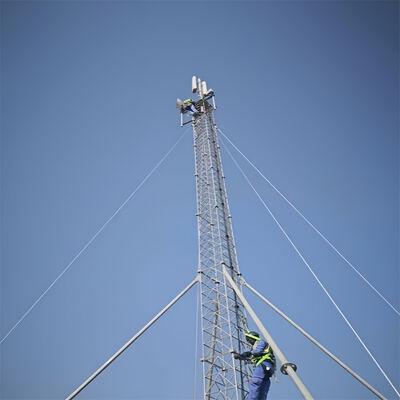
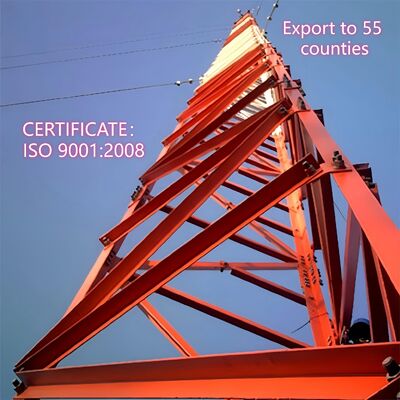
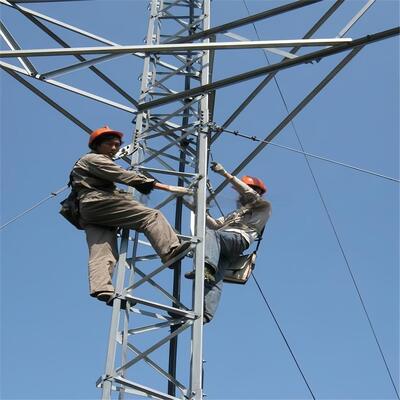
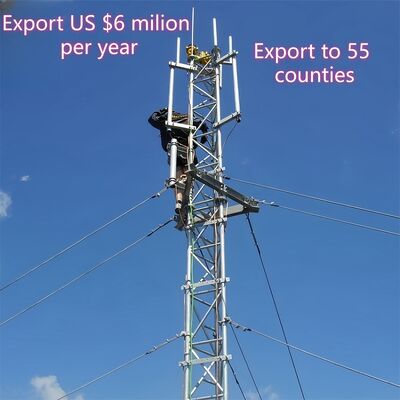
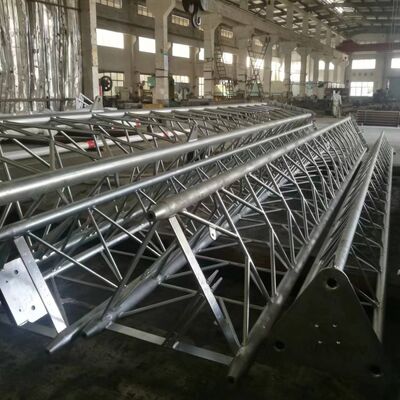
Atorre de mástil arriostrado(también llamada torre arriostrada) es una estructura alta y delgada que depende de tirantes externos (cables de acero de alta resistencia) para su estabilidad, a diferencia de las torres autoportantes que se sostienen de forma independiente. Este diseño le permite alcanzar mayores alturas con menos material estructural, lo que lo convierte en una opción rentable para aplicaciones que necesitan una cobertura o elevación extensa.
-
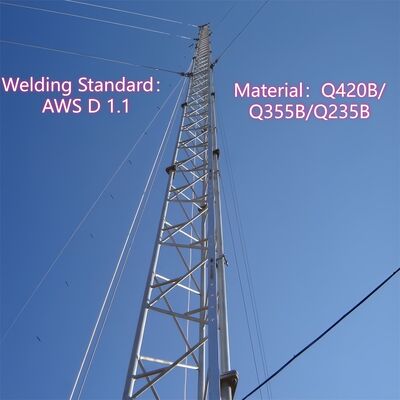
Cuerpo de torre delgada: Construida como estructura tubular o de celosía de acero (más estrecha que las torres autoportantes), con forma cónica para optimizar la distribución de la carga.
-
Sistema de alambre tensor: Varios juegos de cables de acero se fijan al mástil a intervalos de 20 a 30 m, anclados al suelo en ángulos de 45 a 60° para resistir fuerzas sísmicas o del viento.
-
Rango de altura: Se extiende desde 30 m hasta más de 200 m (más alto que la mayoría de las torres autoportantes), personalizable para necesidades específicas.
-
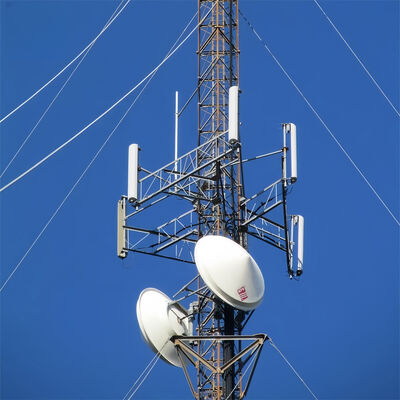
Accesorios: Incluye escaleras para subir, soportes para antenas, bandejas para cables y luces de advertencia de aviación (para alturas >60 m).
-
Cuerpo de la torre: Acero estructural galvanizado (ASTM A36/S235JR) para resistencia a la corrosión y solidez.
-
Cables tensores: Cables de acero de alta resistencia (ASTM A475) con revestimientos de zinc/polímero para mayor durabilidad.
-
Anclas: Anclajes de hormigón/acero de alta resistencia para sujetar cables, diseñados para cargas de tensión.
-
Cumplimiento: Cumple con IEC 62305 (protección contra rayos) y los códigos de seguridad de construcción locales.
-
Radiodifusión/Telecomunicaciones: Admite antenas de TV/radio y transmisores de microondas de larga distancia (maximiza la cobertura de la señal a través de la altura).
-
Monitoreo Meteorológico: alberga sensores/radares meteorológicos en elevaciones elevadas para obtener datos atmosféricos precisos.
-
Navegación de aviación: Monta balizas de aviación en zonas remotas (montañas, costas).
-
Investigación científica: Despliega instrumentos atmosféricos (monitores de ozono) sobre la interferencia del suelo.
1.Especificaciones
| Diseño |
| 1. Código de diseño |
ANSI/TIA-222-G/H/F, EN 1991-1-4 y EN 1993-3-1
|
| Estructura de acero |
| 2. Grado |
Acero dulce |
Acero de alta resistencia |
| GB/T700:Q235B, Q235C,Q235D |
GB/T1591:Q345B, Q345C,Q3455D |
| ASTM A36 |
ASTM A572 Gr50 |
| EN10025: S235JR, S235J0, S235J2 |
EN10025: S355JR, S355J0, S355J2 |
| 3. Diseño de la velocidad del viento |
Hasta 250 kilómetros por hora |
| 4. Deflexión permitida |
0,5 ~1,0 grados a velocidad operativa |
| 5. Fuerza de tensión (Mpa) |
360~510 |
470~630 |
| 6. Límite elástico (t≤16mm) (Mpa) |
355 |
235 |
| 7. Alargamiento (%) |
20 |
24 |
| 8. Resistencia al impacto KV (J) |
27(20°C)---Q235B(S235JR) |
27(20°C)---Q345B(S355JR) |
| 27(0°C)---Q235C(S235J0) |
27(0°C)---Q345C(S355J0) |
| 27(-20°C)---Q235D(S235J2) |
27(-20°C)---Q345D(S355J2) |
| Pernos y tuercas |
| 9. Grado |
Grado 4.8, 6.8, 8.8 |
| 10. Normas para propiedades mecánicas. |
| 10.1 Pernos |
ISO 898-1 |
| 10.2 Nueces |
ISO 898-2 |
| 10.3 Arandelas |
ISO 6507-1 |
| 11. Estándares para dimensiones |
| 11.1 Pernos |
DIN7990, DIN931, DIN933 |
| 11.2 Nueces |
ISO4032,ISO4034 |
| 11.3 Arandelas |
DIN7989, DIN127B, ISO7091 |
| Soldadura |
| 12. Método |
Soldadura por arco protegido con CO2 y soldadura por arco sumergido (SAW) |
| 13. Estándar |
AWS D1.1 |
| Calificación |
| 14. Método de marcado de los miembros. |
Estampado de prensa hidráulica |
| galvanizado |
| 15. Norma de galvanización de perfiles de acero. |
ISO 1461 o ASTM A123 |
| 16. Norma de galvanización de pernos y tuercas. |
ISO 1461 o ASTM A153 |
¿Qué es la torre boday de la torre de alambre arriostrado?
El cuerpo de la torre de una torre de alambre arriostrado (torre de mástil arriostrado) es la estructura central y delgada que soporta antenas, sensores u otros equipos, confiando en alambres de sujeción externos para la estabilidad lateral (en lugar de rigidez autoportante). Generalmente construido como unestructura tubular o de celosía de acero, es más estrecha que las torres autoportantes y presenta un diseño cónico (más ancha en la base, más estrecha en la parte superior) para optimizar la distribución de la carga y la resistencia al viento. El cuerpo de la torre está fabricado con acero estructural galvanizado (que cumple con las normas ASTM A36/S235JR) para garantizar resistencia a la corrosión y durabilidad a largo plazo en ambientes exteriores. Sirve como base de montaje para accesorios clave, como escaleras para subir, soportes de antena y bandejas de cables, y su diseño modular permite la personalización de alturas que van desde 30 m hasta más de 200 m, adaptadas a aplicaciones como radiodifusión, telecomunicaciones o monitoreo meteorológico.
¿Cómo montar la antena en la torre de alambre arriostrado?
El montaje de una antena en una torre de alambre arriostrado sigue un proceso estructurado y compatible con la seguridad alineado con el diseño de la torre y los estándares de la industria:
- Preparación previa a la instalación: Verifique la capacidad de carga de la torre para asegurarse de que pueda soportar el peso de la antena (incluido el hardware y los cables asociados). Inspeccione el cuerpo de la torre en busca de corrosión, daños estructurales o conexiones sueltas y confirme el cumplimiento de los códigos de seguridad locales (por ejemplo, IEC 62305 para protección contra rayos).
- Instalación del soporte de la antena: Coloque soportes de antena dedicados (accesorios integrados de la torre) en puntos predeterminados en el cuerpo de la torre. Estos soportes generalmente se aseguran mediante pernos de alta resistencia compatibles con la estructura de acero galvanizado de la torre, lo que garantiza una conexión firme que resiste las fuerzas del viento y las vibraciones.
- Elevación y posicionamiento de antenas: Utilice grúas o equipos de elevación especializados para elevar la antena a la altura objetivo (elegida estratégicamente para una cobertura óptima de la señal). Alinee la antena con la dirección de transmisión/recepción prevista, utilizando herramientas láser o medidores de alineación para mayor precisión.
- Asegurar la antena: Fije la antena a los soportes preinstalados usando hardware compatible, apretando los pernos al par especificado para evitar el movimiento. Asegúrese de que la antena esté nivelada y estable, sin oscilaciones que puedan afectar el rendimiento o la integridad estructural.
- Enrutamiento e integración de cables: Enrute los cables de señal o alimentadores a través de las bandejas de cables integradas de la torre para protegerlos del daño ambiental. Conecte los cables a la antena y páselos hasta el equipo conectado a tierra, asegurando un aislamiento e impermeabilización adecuados en los puntos de conexión.
- Inspección final: Realice una verificación visual de la antena, los soportes y los cables para confirmar la instalación segura. Pruebe la transmisión/recepción de señal de la antena para verificar la funcionalidad y asegúrese de que se sigan todos los protocolos de seguridad (por ejemplo, protección contra caídas para trabajadores) durante todo el proceso.
¿Qué es el dispositivo antiescalada en la torre de alambre arriostrado?
El dispositivo anti-escalada para una torre de alambre arriostrado es un componente de seguridad especializado instalado en el cuerpo de la torre para evitar el acceso no autorizado y reducir los riesgos de caídas. Los diseños comunes incluyen:
- Cuellos/faldas anti-escalada: Barreras de acero circulares o cónicas montadas cerca de la base de la torre (normalmente a 2 o 3 m del suelo) para bloquear los intentos de escalada negando asideros o puntos de apoyo para los pies.
- Elementos disuasorios puntiagudos o dentados: Accesorios de acero puntiagudos no letales en las secciones inferiores de la torre o escaleras para desalentar la escalada no autorizada.
- Acceso bloqueado: Si la torre está equipada con un panel de acceso a nivel del suelo o un punto de entrada con escalera, una puerta cerrada restringe el acceso únicamente al personal certificado.
Estos dispositivos están construidos con materiales resistentes a la corrosión (p. ej., acero galvanizado, a juego con el cuerpo de la torre) para soportar las condiciones exteriores. Su objetivo principal es mejorar la seguridad evitando la escalada accidental o intencional por parte de personas no capacitadas, alineándose con los códigos de seguridad de construcción locales y mitigando la responsabilidad de los operadores de torres.
¿Cómo conectar un cable arriostrado y una torre de alambre arriostrado?
La conexión de cables tensores a una torre de cables tensados implica un proceso seguro y resistente para garantizar que los cables puedan estabilizar eficazmente la torre contra el viento y las fuerzas sísmicas:
- Preparación: Seleccione cables tensores hechos de cables de acero de alta resistencia (que cumplan con ASTM A475) con recubrimientos de zinc o polímero para mayor durabilidad. Asegúrese de que el cuerpo de la torre tenga puntos de fijación prefabricados (p. ej., orejetas, soportes o crucetas) a intervalos de 20 a 30 m, como se especifica en el diseño de la torre.
- Instalación del hardware adjunto: Monte soportes o abrazaderas para cables tensores de alta resistencia en los puntos de fijación predeterminados de la torre utilizando pernos de alta resistencia (compatibles con la estructura de acero galvanizado de la torre). Estos soportes están diseñados para distribuir la tensión uniformemente por todo el cuerpo de la torre.
- Terminación del cable: Utilice accesorios de terminación profesionales (p. ej., manguitos prensados, abrazaderas para cables o guardacabos) para asegurar el extremo de cada cable de sujeción. Los manguitos estampados se engarzan sobre el cable para lograr una conexión permanente y de alta resistencia, mientras que las abrazaderas para cables proporcionan una tensión ajustable.
- Conexión y Tensado: Conecte el extremo terminado del cable de sujeción al soporte de la torre usando un grillete o pasador, asegurando un ajuste seguro y sin holguras. Utilice una herramienta tensora (p. ej., un tensor o un tensor) para ajustar la tensión del cable a las especificaciones de diseño, algo fundamental para equilibrar las fuerzas laterales en la torre.
- Verificación: Verifique que la conexión esté alineada con la estructura cónica de la torre y que el cable esté tensado uniformemente (evitando apretar demasiado, lo que podría estresar el cuerpo de la torre). Confirme que los herrajes y los accesorios de terminación sean resistentes a la corrosión y cumplan con los estándares de seguridad de la torre.
¿Cómo conectar un cable arriostrado y un perno de anclaje arriostrado?
Conectar cables de sujeción a pernos de anclaje arriostrados (anclajes de tierra) es un paso crítico para transferir la tensión del cable al suelo, asegurando la estabilidad de la torre:
- Preparación del ancla: Asegúrese de que el anclaje al suelo (anclaje de acero o hormigón de alta resistencia, diseñado para cargas de tensión) esté instalado correctamente en el suelo en un ángulo de 45 a 60° con respecto al cable de sujeción. El anclaje debe estar completamente curado (para concreto) e incrustado de manera segura para resistir las fuerzas de extracción.
- Exposición del perno de anclaje: Asegúrese de que el perno superior del anclaje (perno de anclaje arriostrado) sobresalga del suelo y esté roscado para acomodar los accesorios de conexión. El perno debe estar hecho de acero de alta resistencia para soportar la tensión del alambre de sujeción.
- Terminación del cable: Termine el extremo libre del cable de sujeción utilizando los mismos accesorios de alta resistencia (manguitos estampados, abrazaderas para cables o guardacabos) utilizados para la conexión de la torre, asegurando un extremo seguro y capaz de soportar la carga.
- Conjunto de hardware de conexión: Conecte un tensor (para ajustar la tensión) y un grillete al cable tensor terminado. El tensor se conecta al perno de anclaje arriostrado mediante una tuerca o arandela, lo que permite ajustar la tensión del cable.
- Tensado y Aseguramiento: Utilice el tensor para tensar el cable de sujeción según las especificaciones requeridas, asegurándose de que resista las fuerzas laterales sin tirar del ancla. Una vez tensado, bloquee el tensor con pasadores o contratuercas para evitar que se afloje con el tiempo.
- Verificación final: Verifique que la conexión sea segura, que el anclaje no muestre signos de movimiento y que el cable tensor esté alineado en el ángulo correcto de 45 a 60°. Inspeccione si hay corrosión en los pernos, los herrajes y las terminaciones de los cables, garantizando el cumplimiento de la norma IEC 62305 y los códigos de seguridad locales.
¡¡¡Haga clic aquí para obtener más información !!!!!!
3.Clientes de cooperación
4.Certificaciones
5.Nuestros servicios
JIAYAO CO., LTD. es un fabricante profesional de torres de telecomunicaciones y está aprobado por ISO9001. Estamos comprometidos a brindar a los clientes las soluciones más optimizadas y la mejor torre de comunicación. Muchos productos se han exportado a EE. UU., Europa y otros 55 países diferentes.
Nos especializamos en el diseño y fabricación de torres de acero en ángulo, torres de tubos de acero, torres monopolo, torres de pino, torres arriostradas y torres de vigilancia. Nuestros departamentos incluyen departamentos de diseño, I+D, inspección, laboratorio, control de calidad, galvanización y torres de acero. Nuestras materias primas provienen de famosas acerías de China: HBIS Group, Baowu Steel Group, Shougang Group.
Si lo necesitas, ¡te recibiremos las 24 horas del día!

 ¡Su mensaje debe tener entre 20 y 3.000 caracteres!